Terminals
Map where cups enter the passenger journey, where they are used and where return points could work without disrupting passenger flow.

For airports / terminal reuse
Designed around the terminal
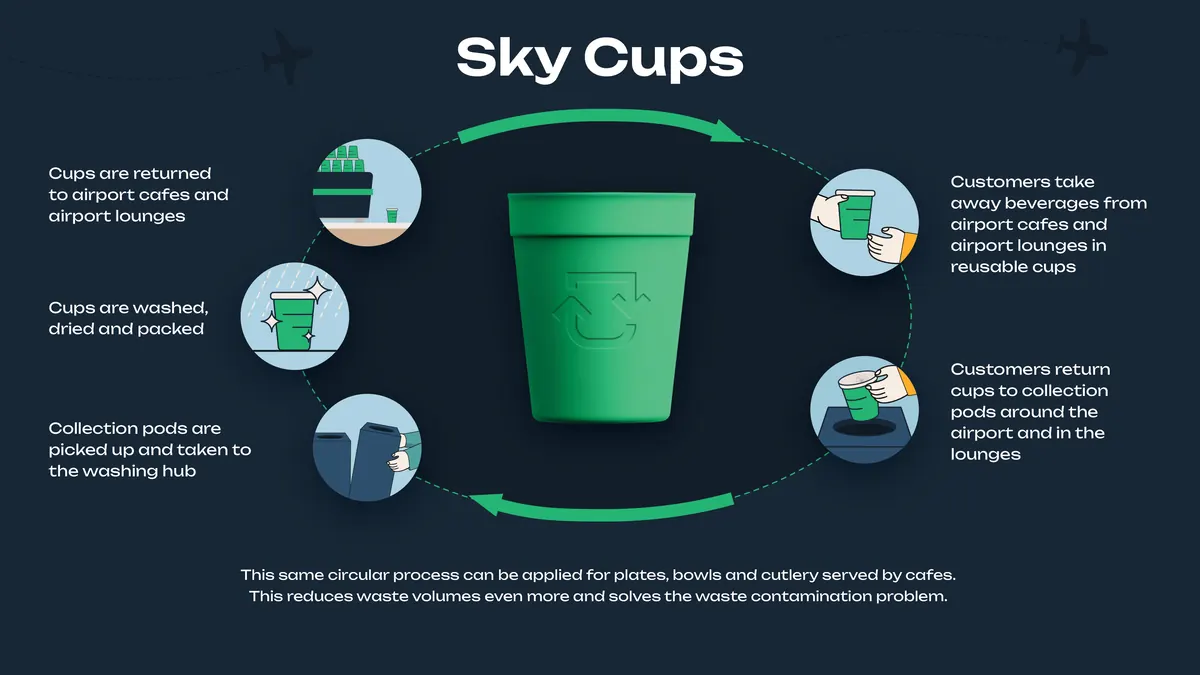
An airport program can cross tenancies, passenger zones and service partners. Sky Cups starts by mapping who supplies, serves, collects, moves, washes and returns each cup—and the operating conditions each team needs the model to respect.
Map where cups enter the passenger journey, where they are used and where return points could work without disrupting passenger flow.
Use a more contained service environment to test cup choice, return behaviour, staff workflows and collection performance.
Coordinate participating food and beverage operators around shared service standards, cup handling and passenger communication.
Plan visible return points, collection frequency, back-of-house movement and the controls needed to keep cups circulating.
A contained place to begin
A pilot can define participating outlets, collection points, wash and logistics arrangements, staff responsibilities and measures before service begins.
Results should be treated as evidence from that operating environment—not as a promise of universal savings or impact.
Start with your airport operation
Frequently asked questions
A considered first conversation starts with the realities of your operation, not a one-size-fits-all promise.
A lounge, precinct or terminal can provide a defined starting point. Sky Cups first maps participating outlets, passenger movement, return points, collection, washing, logistics and team responsibilities through the SkyCycle System™ before recommending a pilot boundary.
See how the SkyCycle System™ works →The operating model needs clear shared requirements for serving, cup handling, returns, back-of-house movement and passenger communication. Sky Cups helps identify the roles and constraints with each participating retailer and service partner; the right arrangement depends on the airport.
The business case compares the full cost of the current single-use system with the proposed reuse system. Airport-specific volumes, procurement, waste, collection, washing, logistics, storage, losses and operating requirements all need to be considered before drawing a conclusion.
Explore the Business Case →Measures should be agreed before the pilot and may include cup return rates, losses, waste reduction, passenger participation, costs and operational performance. Results are evidence from that airport environment, not a guarantee of outcomes elsewhere.
See how impact is measured →No. Sky Cups distinguishes indicative modelling from measured results and does not present an untested scenario as a proven outcome. A defined pilot can establish evidence about what the model achieves in the airport’s own operation.
Start with the operation: the terminal, lounge or precinct under consideration, current cup volumes if available, the teams involved and the questions that need answering. Sky Cups can then help identify the assumptions and practical first step.
Discuss an airport pilot →